
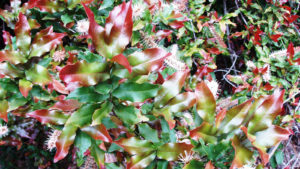
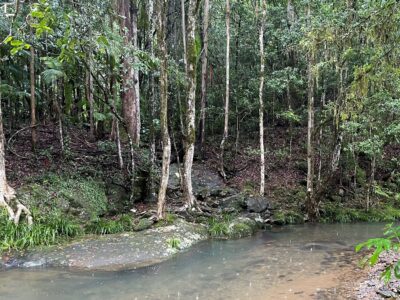
Macadamias are intimately linked with flowing water – animals and birds only carry nuts for a limited distance and gravity will only take a rolling nut so far, but a flowing creek or flooded river can transport a nut in its strong, waterproof shell over many kilometres. Macadamias can disperse downstream rapidly but move up slope much more gradually.
Northern Rivers challenges
Bundjalung Country, including the Northern Rivers of NSW is home to Macadamia tetraphylla (“Bumpy-shelled Bush Nuts”, or just “Bush Nuts” – the southern-most species of macadamia) as well as some of the earliest M. integrifolia orchards, the species which grows naturally along the coast from the NSW/QLD border to Mount Bauple. Many of the early orchards were grown on steep country that had previously been painstakingly cleared of its protective forest cover due to mis-guided government policies. The widescale clearing and replacement of forests for agricultural and housing led to the Richmond River becoming one of the most polluted rivers along Australia’s east coast. Land managers in the Richmond River catchment now struggle with a legacy of steep, cleared land, drained wetlands, invasive species and increasingly extreme weather conditions exacerbated by global warming.
After the devastating floods of 2022, the National Emergency Management Agency developed a program to support flood mitigation and resilience projects. This Northern Rivers Recovery and Resilience Program recognises the need to mitigate the impact of disasters on communities and economies in the region. In addition to improving capacity to anticipate and manage flood risk, funds are available to develop “Nature Based Solutions” so that the environment and communities will be in a better position to recover from future disasters.
Community projects restoring rivers
Projects addressing river and catchment health include Richmond Landcare’s project on Building flood resilience in the Lismore catchment and Heal the Rivers – an Indigenous-led initiative focusing on the restoration of cultural landscapes and implementing nature-based solutions for flood mitigation and adaptation across the Northern Rivers, coordinated by Jagun Alliance. By bringing together the many community groups already engaged in catchment management & restoration projects and working with Local Aboriginal Land Councils and Native Title representatives, this project aims to deliver Aboriginal directed and culturally informed projects to restore riverbanks, wetlands and upper catchment areas and prioritise places and species of cultural significance across the Yarbirri (Tweed), Durrumbul (Brunswick), Baluun (Richmond) and Birrung (Clarence) river catchments.
A third group, Richmond Riverkeepers, monitors the ecological health of the river over time with a report card based on macroinvertebrate sampling.
Bush Nuts getting back on Country
In NSW, Bush Nuts used to grow throughout the Tweed and Brunswick catchments and the north-east Richmond catchment (Wilson River, Terania, Goolmangar and Emigrant creeks). They are now only found scattered in small patches of remnant forest or occasionally left as paddock trees or planted in backyards for their tasty nuts. Wild Macadamia Conservation has been collecting cuttings from throughout the remaining range of M. tetraphylla to preserve genetic diversity and make it available for suitable habitat restoration plantings. In December 2025, we contributed trees to habitat restoration plantings in the upper Richmond and Brunswick River catchments.
Rehabilitating Tucki Tucki Creek
Tucki Tucki Creek in the Richmond River catchment is a case study of how quickly the fortunes of a creek can change. Once gathering rainfall from the forested slopes of the Alstonville plateau, it wound its way through a mosaic of ecosystems, some thickly forested and some managed as open forests by First Nations’ cultural fire management. The creek flowed into the Tuckean Swamp, reputed to rival the Kakadu wetlands for the richness of its bird, fish and plant life. Now its headwaters have been almost entirely cleared to build the suburb of Goonellabah, leaving only a narrow riparian zone, too prone to flooding to be developed.
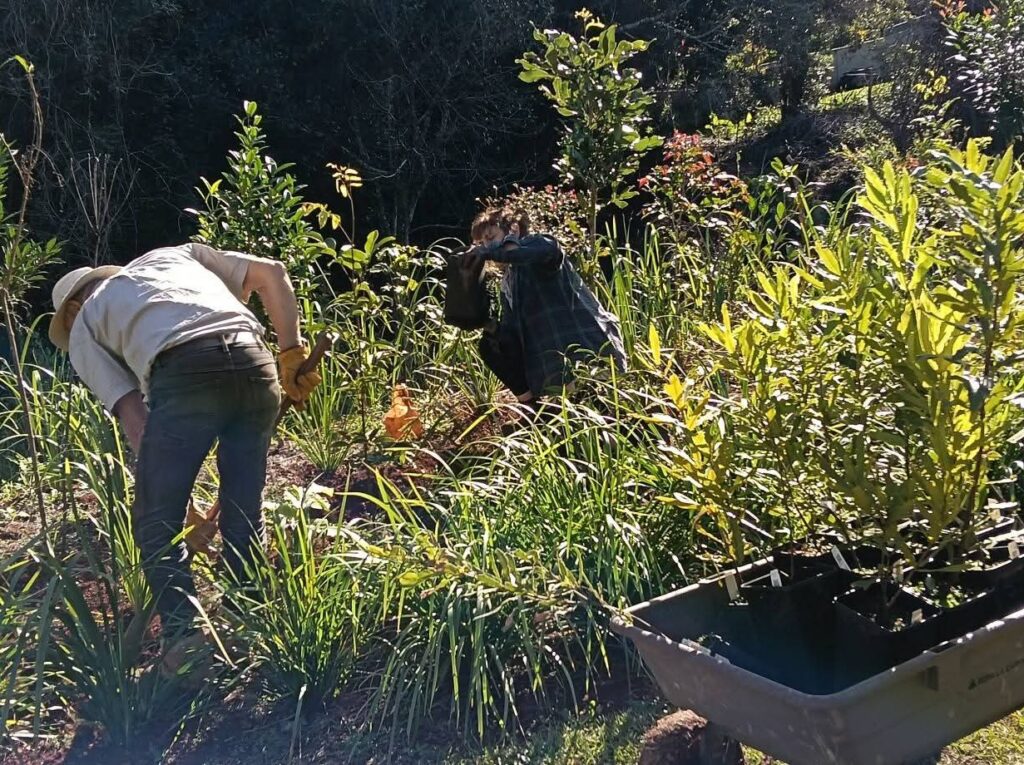
Much love has been lavished on this narrow strip, which against all odds still supports platypus, Richmond birdwing butterflies, catbirds and threatened plant species including Macadamia tetraphylla. The Goonellabah Tucki Landcare group is an active and dedicated group with big plans for Tucki Creek. In 2025 they were awarded a $312,000 grant through the Urban Rivers and Catchments Program, an initiative of the Federal Department of Climate Change, Energy, the Environment and Water, to plant more than 25,000 native plants and help restore the creek as a safe habitat for platypus and all the other flora and fauna that rely on this waterway.
The project was having trouble sourcing suitable planting material for Macadamia tetraphylla (Bush Nuts). Wild Macadamia Conservation has been able to provide 18 trees grown from old, original trees across the Richmond catchment. These trees will provide a genetically diverse source of seeds to restore Bush Nuts along Tucki Tucki Creek.
In a changing climate and subject to new pests, genetic diversity gives the surviving macadamia population more potential to adapt to new conditions.
For details of future planting days, and lovely snippets of platypus action in the creek, see the Goonellabah Tucki Landcare Group’s Facebook page.
 Rescuing Brisbane’s Lost Macadamias