
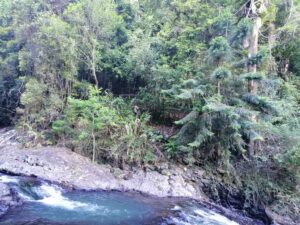
High up in the Numinbah Valley, an ancient population of macadamias survive in Springbrook National Park at the Natural Bridge. Here Cave Creek plunges over a waterfall and under a hard basalt rock bridge and glow worms recreate the night sky under a massive rock overhang. You can find macadamias along the track, and if you get really good at recognising them, you can see some clinging on to the rock face above the glow worm cave and wonder how a nut got lodged there and found enough soil to grow.
Walk with Wild Macadamias
From the visitor entrance, take the stone steps towards the walking tracks – The Macadamia sign is down the steps and to the right of the path, next to a young Macadamia tetraphylla tree.
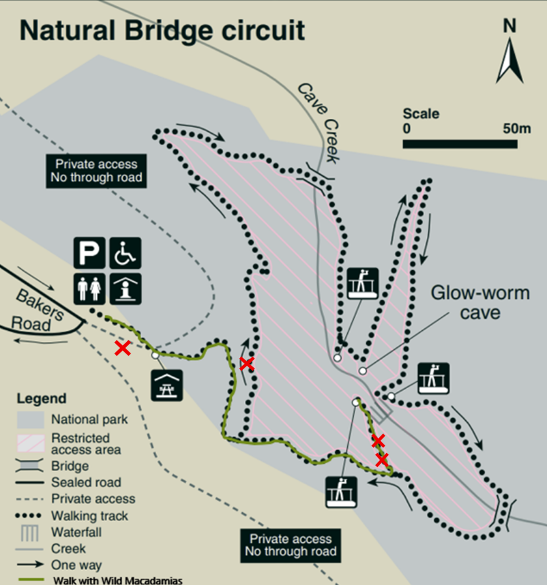
x marks the spot – pause and look for Bush Nuts beside the track here.
Note the four prickly leaves (they can vary from 10 to 30 cm long) and see if you can spot more along the tracks.
Bonus tree! If you stand at the rock wall after the covered entrance area and look towards the two amenities blocks, you can see a slender Macadamia tetraphylla, reaching up to the break in the canopy created by the visitor entrance. Look for the characteristic four leaves and new pink leaves.
The Macadamia sign is down the steps and to the right of the path.
Visit the park website for more details about the park and remember to come clean, go clean.
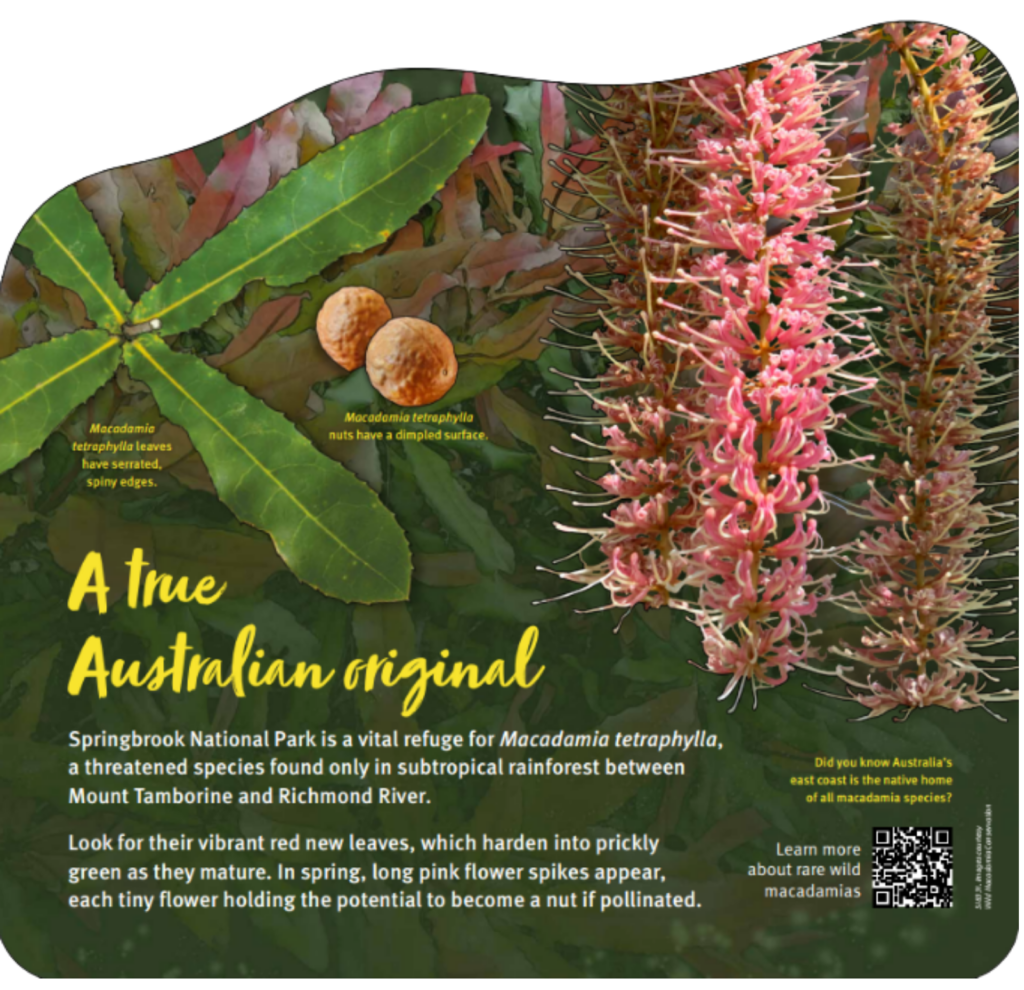
Macadamia tetraphylla (Bush-nut)
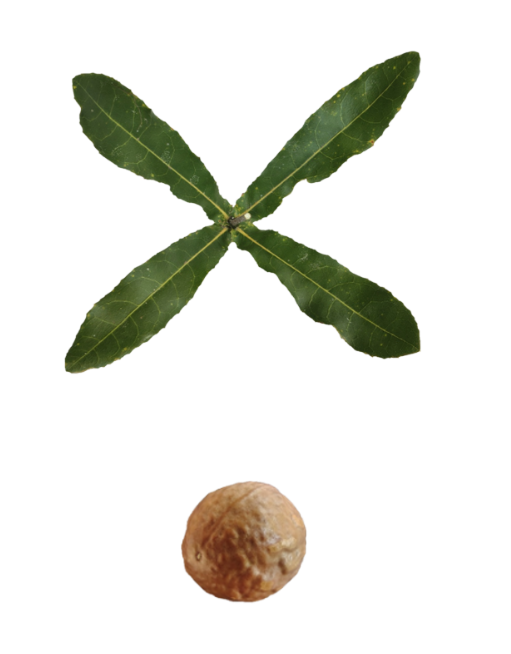
- Macadamia tetraphylla is one of the two edible macadamia species. The flowers and fruits are food for a varity of wildlife including native bees and cockatoos.
- Tetra-phylla is Greek for four-leaves, as the leaves grow four at a time around the stem.
- Young leaves are soft and red, occasionally velvety, turning pink and then green as they mature.
- Mature leaves are prickly with no leaf stalk.
- Close to the track you might see juvenile leaves – as their name suggests, they are the leaves grown by a young tree, or on new shoots from the base of an older tree. They can be enormous and fiercely prickly – why do you think leaves close to the ground might grow like this?
- In Spring, the long pink flowers are made up of hundreds of small individual flowers, each one of which may turn into a nut if pollinated.
- The nuts are covered in a tough, bumpy shell inside a protective green husk.
All macadamia come from Australia
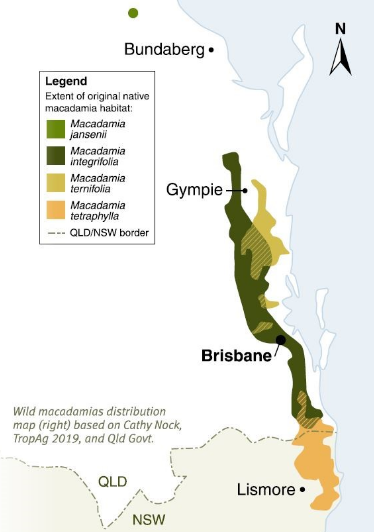
Macadamias evolved in Australia about 30 million years ago. After the last ice age, rainforests on the east coast retreated and macadamia habitat became restricted to a thin strip of subtropical rainforest. Today, all four macadamia species grow in south-east Queensland and Macadamia tetraphylla also grows in northern New South Wales.
For tens of thousands of years, Traditional Owners ate, traded and planted macadamia nuts throughout southeast Queensland and northern New South Wales. They include the Gurang, Gooreng Gooreng, Butchulla, Kabi Kabi, Jinibara, Quandamooka, Yuggera, Turrbal, Yugumbeh, Danggan Balun and Bundjalung peoples.
Macadamia tetraphylla is the southernmost macadamia, growing in sub-tropical rainforest from the Logan River to the Richmond River. Most of its habitat has been cleared and Springbrook National Park is an important refuge for this species.
Wild Macadamias need your help! Sign up as a Wild Macadamia Champion to show your support and learn more about these ancient Australians.