The Lost Brisbane Macadamias need our help
Wild macadamias between the Brisbane and Logan Rivers are now extremely rare and will not survive without our help. Both the Brisbane and Redland City Councils are actively engaged in protecting these heritage trees – now the people of Brisbane and Redlands have an opportunity to collaborate with BCC, RCC and Wild Macadamia Conservation to rescue and protect the Lost Brisbane Macadamias.
Did macadamias grow wild around Brisbane?
Long before people lived in Australia, waterways we now know as the Brisbane and Logan Rivers meandered through a rich diversity of habitats. On a few areas, where closed forest grows on volcanic-derived soils, macadamias were part of complex sub-tropical forest ecosystems.
The Brisbane and Logan River floodplains created zones where macadamias could not survive, so that over millions of years macadamias growing between these two rivers evolved to be genetically distinct from their relatives to the north and south. Macadamia habitat north of the Brisbane River is on the D’Aguilar Range and in the Pine Rivers catchment. South of the Brisbane River, macadamia habitat appears to have been around White’s Hill and Bulimba Creek tributaries, Mount Cotton and Tingalpa Creek. As forest was cleared for the settlement of Brisbane, most of this macadamia habitat was lost – Mount Cotton now has the largest macadamia habitat surviving in the greater Brisbane area.
Using genetics to unravel the macadamia story
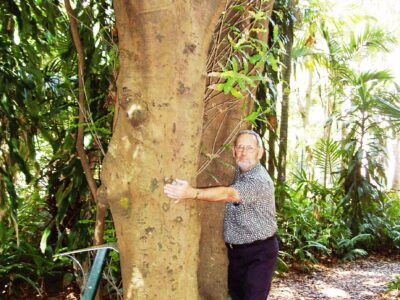
In 2019, chloroplast genome data was used to investigate the population structure of M. integrifolia using a sample of 64 wild and cultivated trees from across the geographic range (Nock et al, 2019). The study found that M. integrifolia is partitioned into five distinct genetic-geographic groups, with historical barriers to seed dispersal between the groups. One of these groups included three old planted trees including the Walter Hill tree (planted in the Brisbane Botanic Gardens in 1858) and a tree taken to California at around the same time. The only wild trees in this group grew at Mount Cotton and in Sankey’s Scrub at White’s Hill – all the others are planted, mostly in old orchards, some in gardens, presumably from nuts collected from the original habitat. These are the “Lost Brisbane Macadamias”.
Finding more trees from the Lost Brisbane Macadamias
In 2022 a further analysis was undertaken of 293 trees using short sequence repeat (SSR) genetic markers, specifically looking for M. integrifolia accessions that include DNA unique to the Lost Brisbane Macadamias. Of the trees tested (including some of the trees identified in the “Wild Macadamia Hunt” supported by the Brisbane City Council), 39 were found to assign over 50% to the Lost Brisbane Macadamias, 21 were over 80% and just 11 trees were over 90%. The original trees from Sankey’s Scrub at White’s Hill were the only wild trees with a high proportion of DNA from the Lost Brisbane Macadamias. An article in the Courier Mail from 1888 titled “The Field Naturalists at Sankey’s Scrub” described young boys collecting “Queensland Nuts” on the mountain – today there are hardly any macadamias left there.
Many of the trees tested from Mount Cotton are related to the Lost Brisbane Macadamias but also to macadamias from the north and south. This suggests that people have moved nuts into Mount Cotton from other areas and that over time, trees grown from these nuts have cross-pollinated with the original trees at Mount Cotton – there are certainly many old backyard trees and a few early orchards.
RACE for a solution
Genotyping is a useful but expensive tool, both for conservation planning and agriculture. A large cross-industry research project is working to develop a rapid low-cost method for genotyping by sequencing: Rapid And Cost Efficient (RACE). Wild Macadamia Conservation is working with the RACE research team to develop a cheaper test specifically for the Lost Brisbane Macadamias. This test would mean that we can sample many more trees that we think might be part of that group, and hopefully add to the core population so that we can restore the Lost Macadamias of Brisbane by planting more of the original trees back into the landscape.
Ultimately we hope RACE will provide a core reference population for the full known range of macadamia genetic diversity – this would help us to assess which trees hold rare DNA (for example some of the old trees in parks and gardens) and where conservation actions are needed to maximise genetic diversity.
Species Recovery Actions: Retain, Restore and Reconnect
Mount Cotton
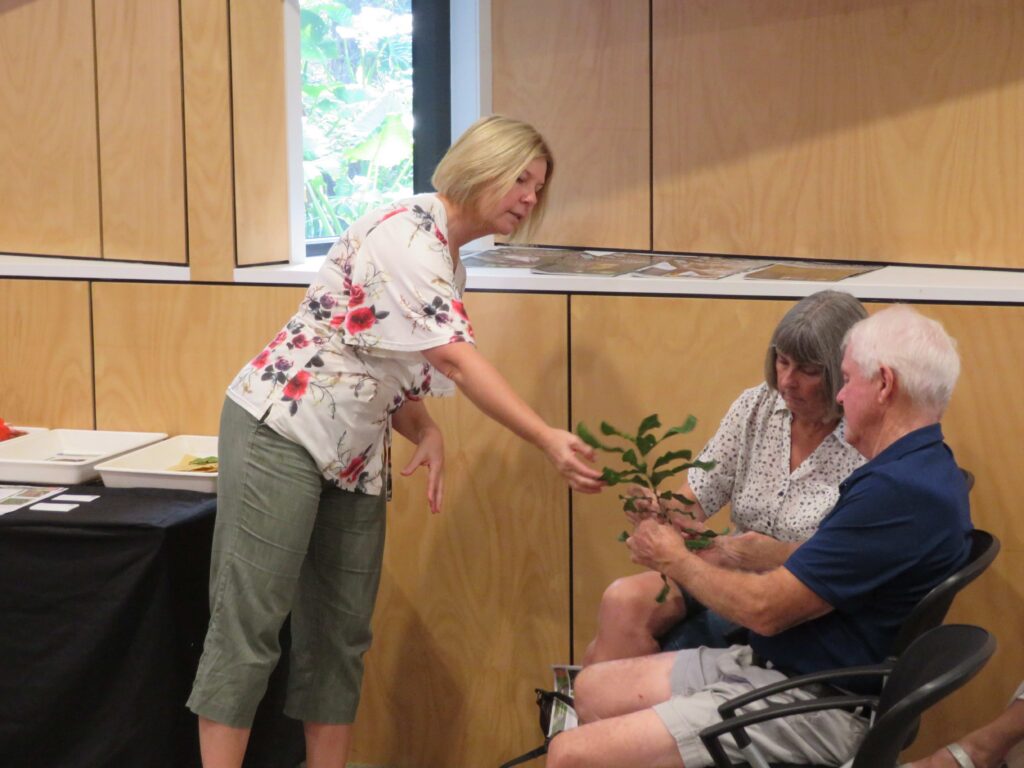
The largest remaining habitat for the Lost Brisbane Macadamias is on Mount Cotton in the Redland City Council (RCC). In 2024, WMC and the RCC embarked on a three year project to protect and expand this habitat to maintain Mount Cotton as a permanent wild macadamia refuge.
Priority actions for the project are:
- Identify and map locations of wild macadamia populations.
- Engage with landholders to manage threats to wild macadamia populations through restoration projects (planting/weed management/fencing as needed) and deliver financial support through SmartyGrants.
- Collect leaf samples from key macadamia specimens for genetic analysis.
- Review options for protection mechanisms on private property.
- Engage key stakeholders including First Nations representatives to advise on educating the broader community on values/threats to macadamia populations.
There are seven landholders now working with RCC to protect macadamias on their property, and in 2026 we’ll be collecting leaf samples from potential Lost Brisbane Clade trees.
 The mysterious Mount Bauple
