
There are four species of Macadamia, two with edible nuts and two without….
There are four species of Macadamia, two of which are used for production of Macadamia nuts in Australia and around the world (Macadamia integrifolia and M. tetraphylla). The other two species have bitter nuts and are not safe to eat (M. ternifolia and M. jansenii). All of them occur naturally only on Australia’s east coast.
All four are closely related and some have overlapping ranges. There is some natural hybridisation between Macadamia species where they share habitat, but how much and what impact it has on the species has not yet been studied.
Download our quick guide to macadamia identification
The four species of macadamia, with clues in their names
Macadamia leaves tend to grow three or four at a time around the stem (called a whorl). However, there are always exceptions to this rule, with odd cases of single leaves or groups of five leaves.
Three of the species characteristically have three leaves per whorl. Macadamia ternifolia was the first scientific name used for macadamia, referring to its three leaves: terni-folia is Latin for three-leaves.
It took a while for early botanists to agree that Macadamia integrifolia and Macadamia ternifolia were different species, leading to all sorts of confusion with mis-labelling of early herbarium specimens. However, once it was established that there was indeed a second species (with the added bonus of delicious nuts!), an obvious feature that set the edible species apart from Macadamia ternifolia (which has serrated leaves), was its much smoother adult leaves. Thus the second species was called integri-folia, which is Latin for integrated-leaf, referring to its smooth leaf edges. A confusing characteristic of M. integrifolia is that it tends to have very prickly leaves as a juvenile, making it harder to distinguish seedlings and saplings.
Macadamia tetraphylla is the exception to the three-leaf rule, with four prickly leaves often symmetrically arranged (like a cross). So the next species to be named was called tetra-phylla which is Greek for four-leaves.
By the time a fourth species was found, by dedicated naturalists Ray Jansen and Keith Sarnadsky, it was time to drop the leaf references, and name it in honour of Ray Jansen: Macadamia jansenii. It has three leaves with smooth edges. Ray spent many hours exploring Central Queensland, finding both a new macadamia species and a new Cooloola Monster (Cooloola ziljan named after Ray and fellow naturalist Eric Zillman).
Macadamia integrifolia – Bauple Nut or Queensland nut tree
The nut we love to eat
‘integ’ means entire and ‘folia’ leaves
This is the species that gave the world the macadamia nut – and yet wild trees of this species are now rare across much of their original rainforest habitat.
Where is it found: From the Gold Coast hinterland to Mt Bauple near Maryborough. It overlaps with M. ternifolia to the north and M. tetraphylla to the south.
How high does it grow: This species grows up to 25m high
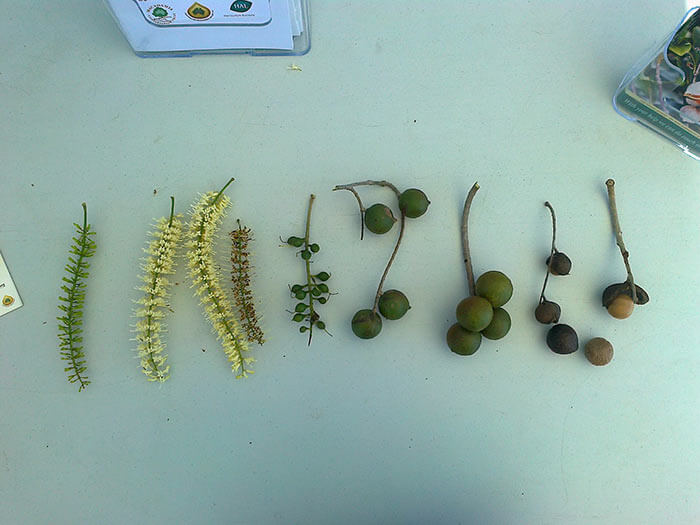
What does it look like? Seedling leaves can be large and prickly, but mature leaves have smooth edges, generally with three leaves to each node, new flush pale green, flowers white and the shells are smooth.
Common names: Queensland Nut, Bauple Nut, Baphal Nut, Smooth-shelled Macadamia
Other information: This is the species commonly grown in Australian macadamia orchards while in South Africa, which also grows lots of macadamias, the common varieties are hybrids between M. integrifolia and M. tetraphylla.
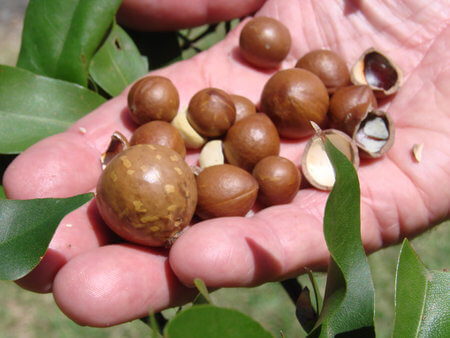
Bulburin Nut, with a common commercial variety of macadamia nut at the far left for size comparison. Photo courtesy of Scott Lamond, ABC
Macadamia jansenii – Bulburin Nut
Critically endangered rainforest survivor
Named after Ray Jansen who brought it to the attention of western science in 1991.
The Bulburin Nut exists in a single location in one national park in central Queensland, making it one of the rarest trees in Australia.
Where is it found: Bulburin National Park, Queensland, 160km north of all other macadamias
How high does it grow: This species grows up to 8m high
What does it look like? It has three leaves at each node with smooth, wavy edges and the new flush is coppery-bronze. Flowers are cream and the nuts are small and inedible with smooth, shiny shells. Its smooth bark is patterned with small crescent moon shapes – tiny lenticels that allow the tree to breathe through the bark.
Common names: Bulburin Nut, Jansen’s Macadamia
Other information: Macadamia jansenii is critically endangered – as rare as the Wollemi pine. It has a tiny distribution of around 200 trees along a single creek. Fortunately, that creek is protected in a national park, but even with the best management, these few trees are at risk of a catastrophic event, such as a fire, pest or disease outbreak.
Leaves are not the only part of plants that breathe – some tree trunks, tubers and even fruit have lenticels – groups of cells that, although they don’t photosynthesize, still respire, allowing the exchange of carbon dioxide, oxygen and water vapour through the outside layer of the plant.
Macadamia tetraphylla – rough-shelled bush nut, Bush Nut, Gumbur
Guards its nuts with prickly leaves
‘tetra’ is Greek for four and ‘phylla’ leaf
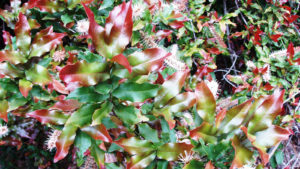
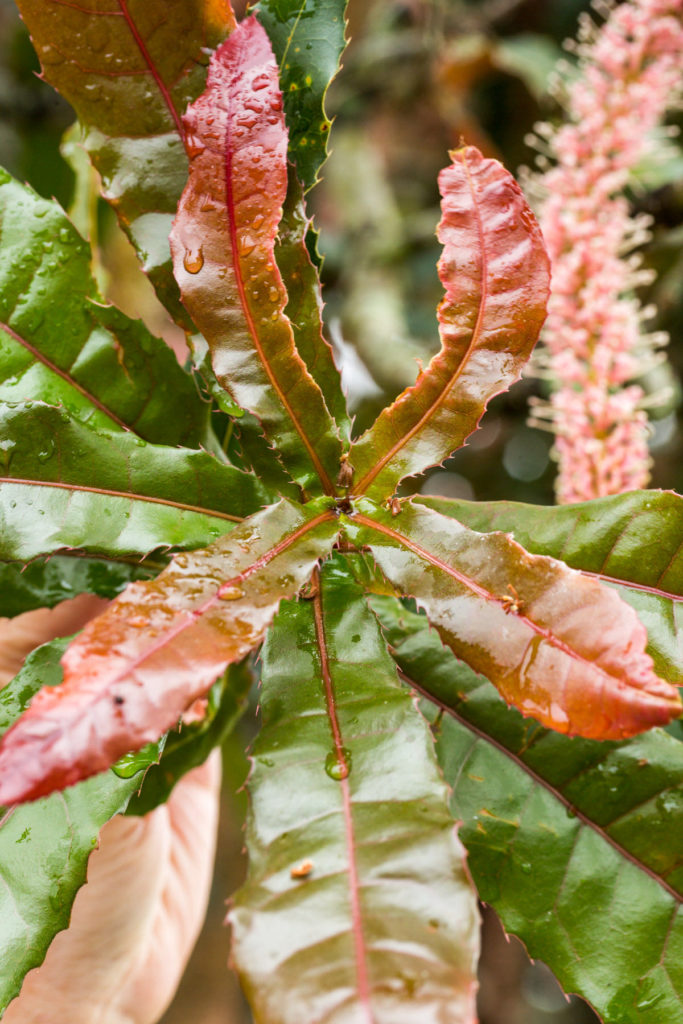
The Bush Nut is easy to identify by its vivid pink flowers and four spiny leaves at each node. New leaves flush a variety of colours, from pink to red to orange depending on the individual tree.
Where is it found: From the Richmond River in New South Wales to the Logan River in SE Queensland
How high does it grow: This species grows up to 20m high
What does it look like? It has four spiny leaves arranged as a cross at each node, and some leaves can be up to 20cm long. Flowers are shades of pink and new leaf flush can be pink, red or orange. The brown shells are dimpled and bumpy.
Common names: Bush Nut, Rough-shelled Macadamia, Gumbur (Nyangbul language)
Other information: Bush Nuts have been eaten, planted, shared and traded by Bundjalung and other First Nations for thousands of years. European settlers tried to grow them in plantations but they ended up being abandoned in favour of the M. integrifolia cultivars brought back from Hawaii in the 1950s.
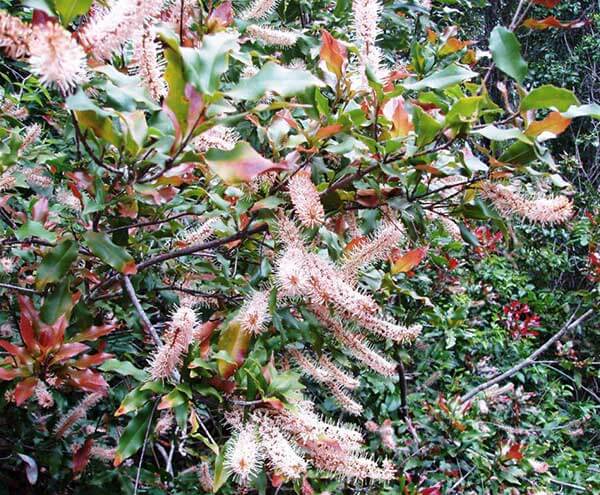
Macadamia ternifolia – Maroochy or Gympie nut
Delicate and colourful but stay away from the bitter nuts
‘terni’ means three and ‘folia’ leaves
This is an intriguing species, with habitat similar to M. integrifolia but seldom overlapping. It can grow as a multi-stemmed bush or a small tree and its nuts are intensely bitter.
Where is it found: North of Brisbane to Gympie in south-east Queensland.
How high does it grow: This species grows up to 18m high
What does it look like? The leaves grow three at a time with serrated edges and a pointed tip. The new leaves flush pink to deep red, and flowers can be white or pink. The nuts are small with smooth shells.
Common names: Maroochy Nut, Gympie Nut
Other information: Much of its remaining habitat is along creeks and gullies, in forest strips too small to be mapped at government planning scale and thus not protected from land clearing. The more people recognise it, the better we will be able to protect its habitat.
Find your local species
See where each of these four species grows near you. Explore the Wild Macadamias App to find your local habitat zone.