
Evolution
Back in the mists of time as Australia was separating from the mega-continent of Gondwana, the Proteaceae family of flowering plants was evolving to include Banksias, Grevilleas, Hakeas and Macadamias.
Fossilised pollen of a plant that we recognise as an ancestor of Macadamia has been found in central Queensland and dated to about 50 million years old.
At that time much of eastern Australia was covered in rainforest and Macadamias existed up and down the east coast.
Massive climate changes resulted in the rainforest retreating and separating Macadamias from their northern cousins, now classified as Lasjia.
Isolation and other pressures resulted in Macadamias evolving into the four species we recognise today.
Since the end of the last ice age 10,000 years ago, Macadamias have probably only existed in isolated pockets of rainforest, generally near the first inland ranges from the Pacific Ocean.
The First Australians
Indigenous Australians were the first to harvest and trade macadamia nuts, both as a food source and for other uses. They generously showed the nuts to early explorers and settlers.
There was a diversity of Peoples and languages across macadamia habitat, and original names for the species included Kendal, Gyndl/Jindill, Goomburra, Boombera and Baphal’s nuts.
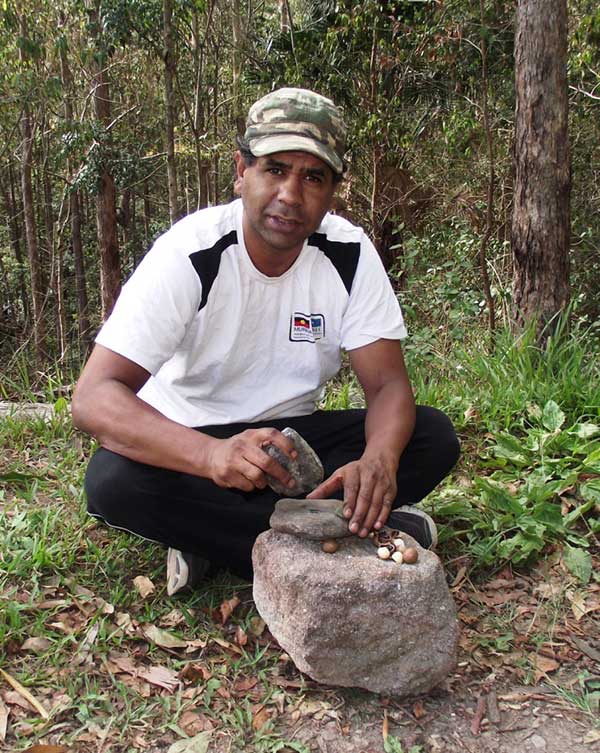
Cracking rocks have been found that used an efficient technique to crack the shell without shattering the nut within (see photo). A large base rock with a depression is used to hold the nut, which can be placed in the best position for cracking (attachment scar facing down). A flat rock is placed over the nut and a hammer rock used to strike the flat rock. This distributes the force of the blow to facilitate a clean break, rather than crushing the shell with a direct hammer blow.
Much of the cultural and natural history of macadamias remains undocumented and Wild Macadamia Conservation is working with First Nations Australians and invites others to work with us to preserve and honour this cultural heritage as well as protecting macadamia trees and their habitat.
WMC acknowledges the Traditional Owners of macadamia habitat and pays respect to past and present elders and the generations yet to come.

Since European settlement
The first Macadamia specimens were collected by the explorer Ludwig Leichardt in 1843 about 60km north of Brisbane.
From 1860, settlers discovered the fine eating qualities of Macadamias, which were subsequently widely planted in farm yards and backyards as single trees grown from seeds of local wild stock.
You can visit one of the first macadamias planted in the new settlement of Brisbane at the Brisbane Botanic Gardens. Planted in 1858 by Walter Hill, the first superintendent of the Gardens, the tree is still healthy and producing nuts.
Macadamia nut industry
The earliest attempt to grow Macadamias as a commercial crop was probably at Rous Mill near Lismore in the 1870s. However, the fledgling Australian industry failed to develop due to variable production, native insect pests and lack of processing technology to extract the nuts from their husk and shell.
In the 1920s, a commercial macadamia industry was established in Hawaii, based on nuts sourced from south east Queensland rainforests. The Hawaiian Agricultural Experiment Station assessed thousands of seedlings to select varieties that were then adopted as the basis of the developing Australian and global industries.
Australia is now one of the world’s largest producers of Macadamia nuts, with South Africa, China and Kenya. In 2025 the Australian industry grew 43,800 tonnes of macadamia nuts in their shells, produced by about 800 growers on 38,000 hectares of land, with another 8,000 hectares of young trees. Around 72% of the nuts were exported with a value of $275 million.
For all the twists and turns of the macadamia industry development in Australia and internationally, see Ian McConachie’s book The Macadamia – Australia’s Gift to the World.