
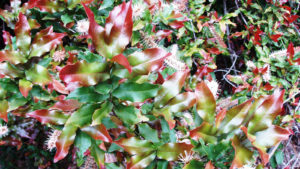
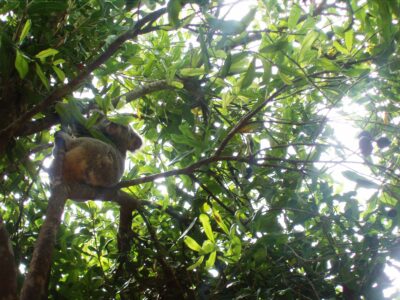
Macadamias and Koalas followed different evolutionary paths from most other flowering plants and mammals respectively over 100 million years ago, evolving complex survival mechanisms tuned to the southern hemisphere. Faced with today’s rapidly changing environment, both of these much loved species need our help. WMC is dedicated to helping macadamias, and you can learn more about efforts to help Koalas in NSW and QLD.
Going their own way
Macadamias are to almonds, walnuts, pistachios and Brazil nuts what marsupials are to placental mammals: an ancient off shoot of the evolutionary tree. The Proteaceae family (including Macadamia, Grevillea, Banksia and Hakea) diverged from the ancestor of most other flowering plants not long after marsupials diverged from placental mammals.
So while macadamias may look similar to other nut-bearing trees, they have had well over 100 million years to evolve their own survival strategies, such as proteoid roots for accessing phosphorus from ancient, weathered soils. The more we understand about how macadamias thrive in their natural environment, the more tools we have to help them survive the rapid changes of the last few hundred years: loss of more than 80% of their habitat, a more extreme and generally warmer climate, and an onslaught of voracious introduced species like lantana and Cat’s Claw creeper that thrive in an environment devoid of their natural predators.
Learning more about macadamias is important, but protecting what remains is critical, and in 2026 WMC is partnering with local groups in Queensland and NSW to protect and restore habitat.
Amamoor Creek Cat’s Claw management
Cat’s claw creeper is an escalating threat to Australia’s tropical and sub-tropical forests. Wild Macadamia Conservation partners with local experts to keep this smothering vine away from vulnerable macadamia populations. The latest project is with Gympie and District Landcare Group (GDLG) in Queensland to tackle invasion of wild Macadamia integrifolia habitat by Cat’s Claw, lantana and Red Coral Berry along Amamoor Creek and around the Walk with Wild Macadamias.
Wild Macadamia Conservation recently met with experts from GDLG and Queensland Parks and Wildlife Service (QPWS) to develop a plan for monthly inspection and control along Amamoor Creek. With the appropriate permit to work in Protected Areas, Wild Macadamia Conservation is providing funds for GDLG staff and volunteers to work outwards from macadamia habitat, strategically cutting and poisoning weeds and releasing biological controls as appropriate to combat Cat’s Claw and other high priority weeds.
Protecting macadamia habitat protects the biodiversity of subtropical rainforest and the water quality of creeks supported by healthy riparian vegetation.
Mount Cotton
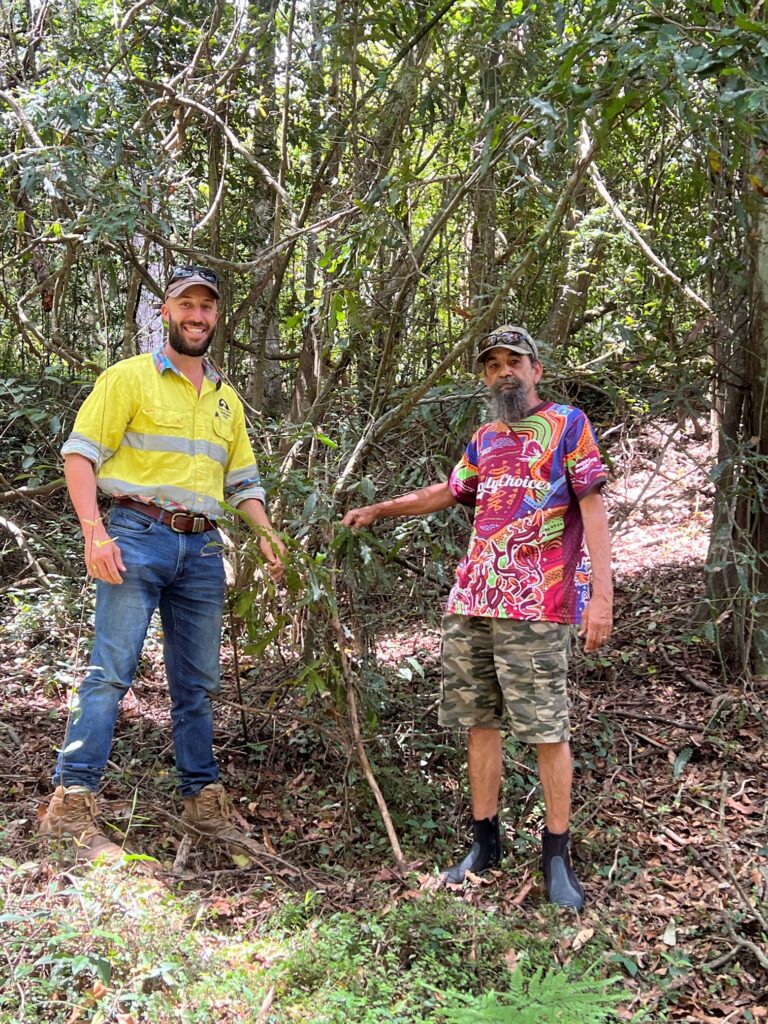
Mount Cotton south of Brisbane has the largest remnant habitat for the Lost Brisbane Clade of M. integrifolia (the Walter Hill tree and its relatives). WMC is working with Redland City Council and interested landholders to protect and expand this habitat to make Mount Cotton a permanent wild macadamia refuge.
Bush Nuts getting back on Country
Find out more about macadamia habitat restoration in the Northern Rivers.
 Bush Nuts and Water