
New project to inform Macadamia ternifolia conservation efforts
Little is known about this species, but that is about to change with a new 3-year project led by Professor Alison Shapcott. For 100 years all macadamias were called Macadamia ternifolia (meaning three-leaves in Latin), leading to labelling mistakes that persist today. In 1956 the name M. ternifolia was assigned to the smallest species with inedible nuts. Initial surveys established that, like all wild macadamias, this species is vulnerable to extinction (mainly from habitat loss), but our knowledge of where it survives and the geographical distribution of its remaining genetic diversity is minimal.
Internationally recognized rainforest ecologist Professor Alison Shapcott has been awarded funding for a three-year research project, starting in August 2026 to improve our knowledge of this threatened species and inform conservation efforts for its survival. The Macadamia ternifolia resilience assessment and planning project is proudly funded by the Queensland Government and delivered by the University of the Sunshine Coast and Wild Macadamia Conservation.
What’s in a name
Reading through old newspaper articles and reports you could be excused for thinking that M. ternifolia grows up and down the East Coast of Australia, when its actual distribution is a short 150km stretch of the Queensland coast. This small macadamia with intensely bitter nuts only grows in remnant rainforest from Mount Nebo to Goomboorian. The confusion arises from all macadamias being called M. ternifolia for about a hundred years.
For example, this illustration from 1904 is not what we now know as M. ternifolia!
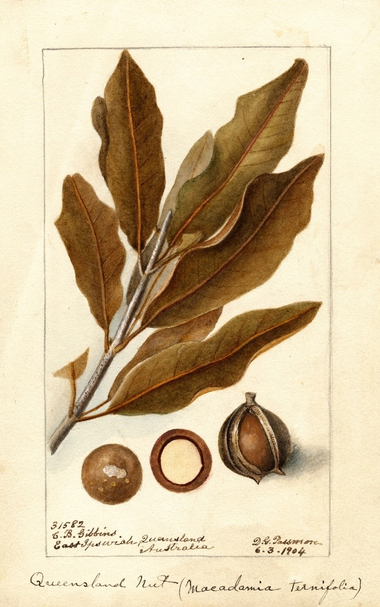
Although the four macadamia species are quite distinctive, it took a long time for botanists to sort them out and formally describe them as separate species. Macadamia ternifolia was the first scientific name given to macadamias by Ferdinand von Mueller in 1857, despite some trees having edible nuts and others being inedible. The name terni-folia means three-leaves in Latin, referring to the way three leaves grow at each node or whorl. Over time, use of this single name caused much confusion over labelling of herbarium specimens and other historical records and an anomaly in the cosmetics industry which still today persists in labelling macadamia oil as M. ternifolia instead of M. integrifolia.
It was not until 1956 that Queensland Government botanist Lindsay Smith collected specimens from across macadamia habitat and proposed three species. One of the features that distinguished trees with edible nuts north of Brisbane from those with bitter nuts, was the much smoother edges on adult leaves. Thus the edible species was called M. integrifolia, meaning entire or undivided leaf, referring to its smooth leaf edges.
The trees with edible nuts and prickly leaves that grow further south were even easier to distinguish as they generally have four leaves symmetrically arranged (like a cross) and are very prickly. So this species was called tetra-phylla which means four-leaves in Greek. M. tetraphylla grows from the Gold Coast down to the Richmond River.
By the time a fourth species was found north of Bundaberg, by local naturalists Ray Jansen and Keith Sarnadsky, it was time to drop the leaf references, and name it in honour of Ray Jansen: M. jansenii.
The Macadamia ternifolia resilience assessment and planning project
When the Queensland government announced funding in 2025 for Protecting Queensland’s Threatened Species: Applied Research Grants, Wild Macadamia Conversation was very pleased to be able to work on a M. ternifolia proposal with rainforest ecologist and macadamia expert Professor Alison Shapcott.
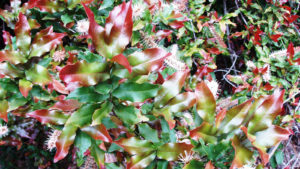
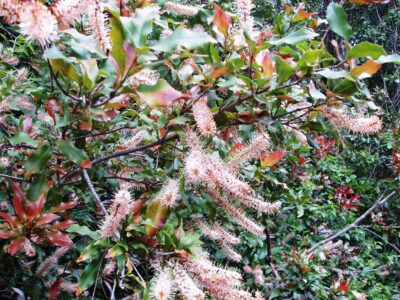
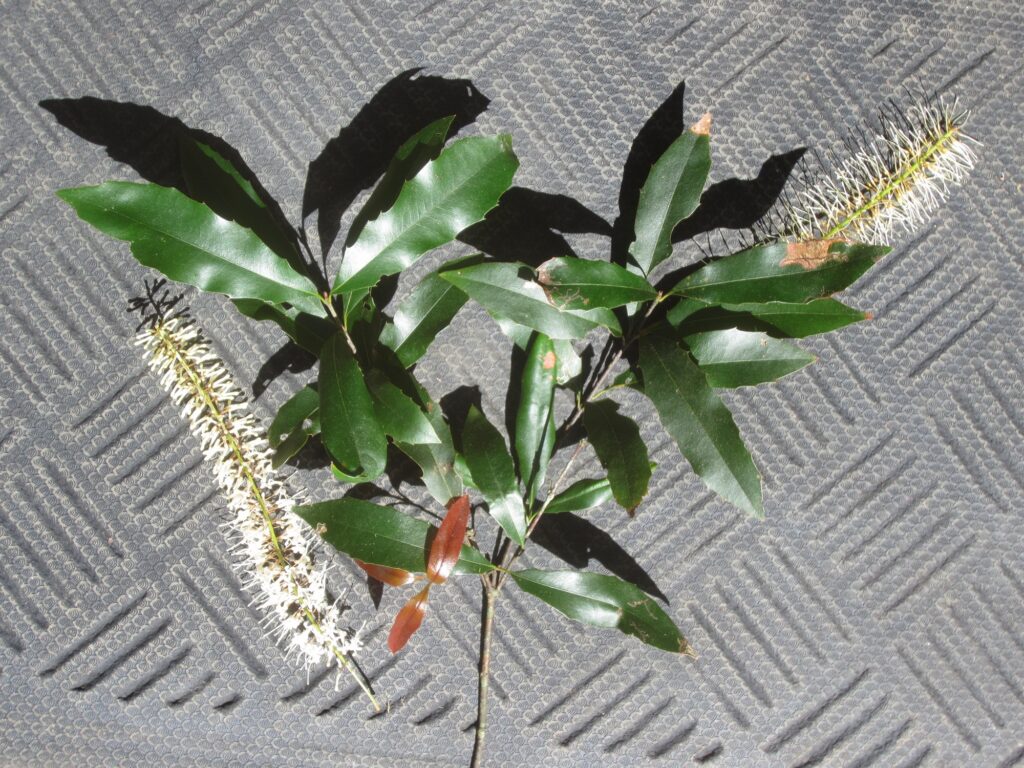
Endemic to Mount Nebo and the Sunshine Coast, M. ternifolia grows as a small tree or multi stemmed shrub, with shiny, dark green leaves, a beautiful pink to red leaf flush and creamy white to pink flowers. It has been largely overlooked for population genetics research, and this project addresses this gap identified in the National Recovery Plan for Macadamia Species.
Research Officer Amber Gould has already started to engage with First Nations and Native Title groups, local conservation groups and land managers prior to undertaking comprehensive field surveys and identifying regenerating or declining populations. This data will be mapped against current populations and Native Title and Protected Area status to find resilient metapopulations, update habitat and climate models and advise on recovery strategies.
Leaf samples will be used for a comprehensive genetic analysis to determine spatial patterns of diversity and distinctiveness and identify geographic spatial genetic clusters and the scale of genetic clustering if it exists. This will provide advice for recovery actions such as provenance sourcing.
If you know of a population of wild M. ternifolia that should be included in this project, please email denise.bond@wildmacadamia.org.au.
The Macadamia ternifolia resilience assessment and planning project is proudly funded by the Queensland Government and delivered by the University of the Sunshine Coast and Wild Macadamia Conservation.
 Which insects visit Bush Nuts in the forest?