
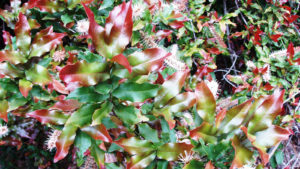
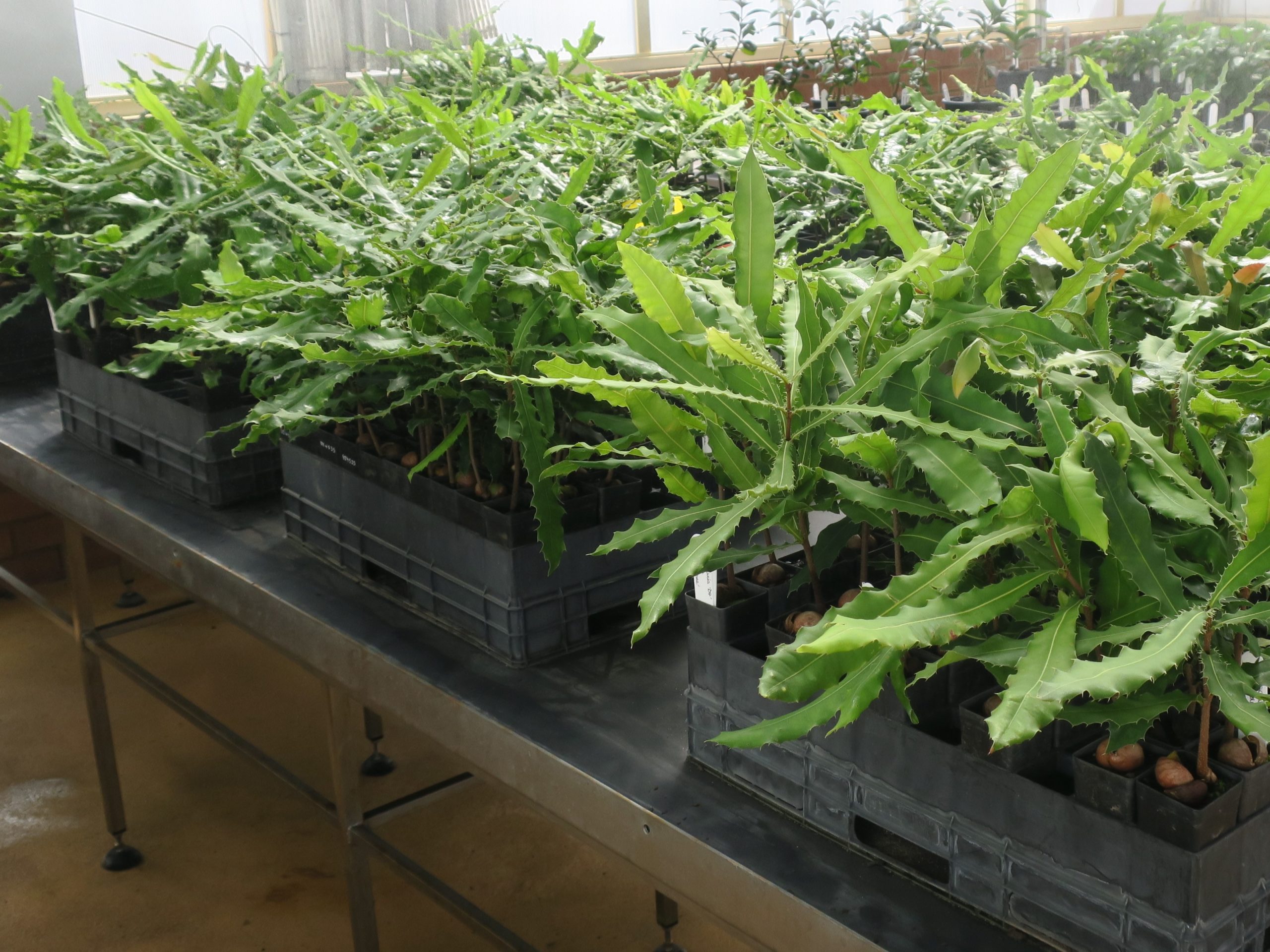
In 2018 we reported on trials at the Royal Sydney Botanic Gardens to dry and store macadamia seeds and retain their viability (see below). There were exciting initial results, with some seeds germinating after storage in liquid nitrogen for a month, but subsequent trials showed that germination and survival was not consistent, and that that drying or freezing of whole macadamia nuts is not a dependable way to store precious germplasm.
Researchers at the Australian Institute of Botanical Science continued working with the University of Queensland to figure out world-first ways to store wild and cultivated macadamia genetic material and ultimately ensure the long-term survival of the species.
In 2024, MCT (now WMC) awarded the Ian and Janet McConachie Macadamia Conservation Research Grant to Dr Albert Wong to continue research into alternative ways of storing germplasm with a focus on Macadamia jansenii.
Early seed-banking research
In May 2018, MCT contributed fresh macadamia nuts to the Rainforest Seed Conservation Project of the Royal Botanic Garden Sydney. Most wild and cultivated varieties of our major food crops are zealously stored in seed banks across the world, but what about macadamias? Rainforest seeds are not easy to store long-term, but researchers are working out techniques so that rainforest species can be added to our stores of grains and vegetables.

It is comforting to know that there are global organisations such as Crop Trust storing examples of the world’s biodiversity in secure seed banks. This is an invaluable resource for our long-term food security as well as for protecting biodiversity but large, oily seeds like macadamias pose a challenge. They are not as easy to store as grain crops like wheat and rice – in some cases, rainforest species can only be stored as living plants, like the ex-situ plantings of Macadamia jansenii, or as frozen germplasm, which is currently an expensive option. The Royal Botanic Garden Sydney science team is addressing this challenge through a six-year project, and in May 2018 started experiments on macadamias seeds.
The macadamia project is looking at the germination potential of fresh seed compared with germination of:
- seed dried to 5% moisture content
- seed dried to 15% moisture content
- seed dried and then stored for one month at 4°C
- seed dried and stored for one month at -20°C.
Seeds at the three different moisture contents (full, 15% and 5%) will also be run through a Differential Scanning Calorimeter, a machine that gradually lowers the seed temperature to -150°C then raises it again to around +40°C, recording any sudden release of energy as the seed freezes, and absorption of energy as the seed thaws. The results will give insights into the temperatures at which macadamia oil inside the seed freezes and thaws, which will help determine the best temperature to try for long term storage.
Living, breathing ecosystems are the ideal biodiversity conservation sites, but seed banks are an important back-up for the preservation of genetic diversity.
 Wild macadamias listed on the IUCN Red List